From medieval illuminations to modern illustrations, this course looks at how Western artists have worked as illustrators throughout the years
Online course (Zoom)
Mondays, from 10 am to 12
5 weeks, starting on 9 November and ending on 7 December 2026
Cost: £70 (scroll down for payment button)
If you miss a session, you will have the slides and “video-notes” to catch up.
This course is now full. If you’d like to be on the waiting list, please message me (see “contact” above). Thanks!
This five-week art history course explores the fascinating relationship between fine art and the illustrated book, tracing a history that begins with medieval illuminated manuscripts and culminates in the richly illustrated publications of modern era.
We will begin with the handcrafted splendour of medieval manuscripts, considering the role of illuminators, scribes, and workshops in creating books that were both devotional objects and works of art. From there, we will explore the impact of print culture and the growing collaboration between artists, publishers, and authors. Particular attention will be given to the nineteenth and twentieth centuries, when many prominent painters accepted commissions to illustrate literary classics, poetry, fairy tales, and contemporary works.
Through a selection of case studies, participants will discover how artists adapted their styles to the page, negotiated the relationship between image and text, and brought new interpretations to familiar stories. Along the way, the course will examine changing artistic techniques, publishing practices, and audiences, revealing the illustrated book as an important meeting point between art, literature, and visual culture.
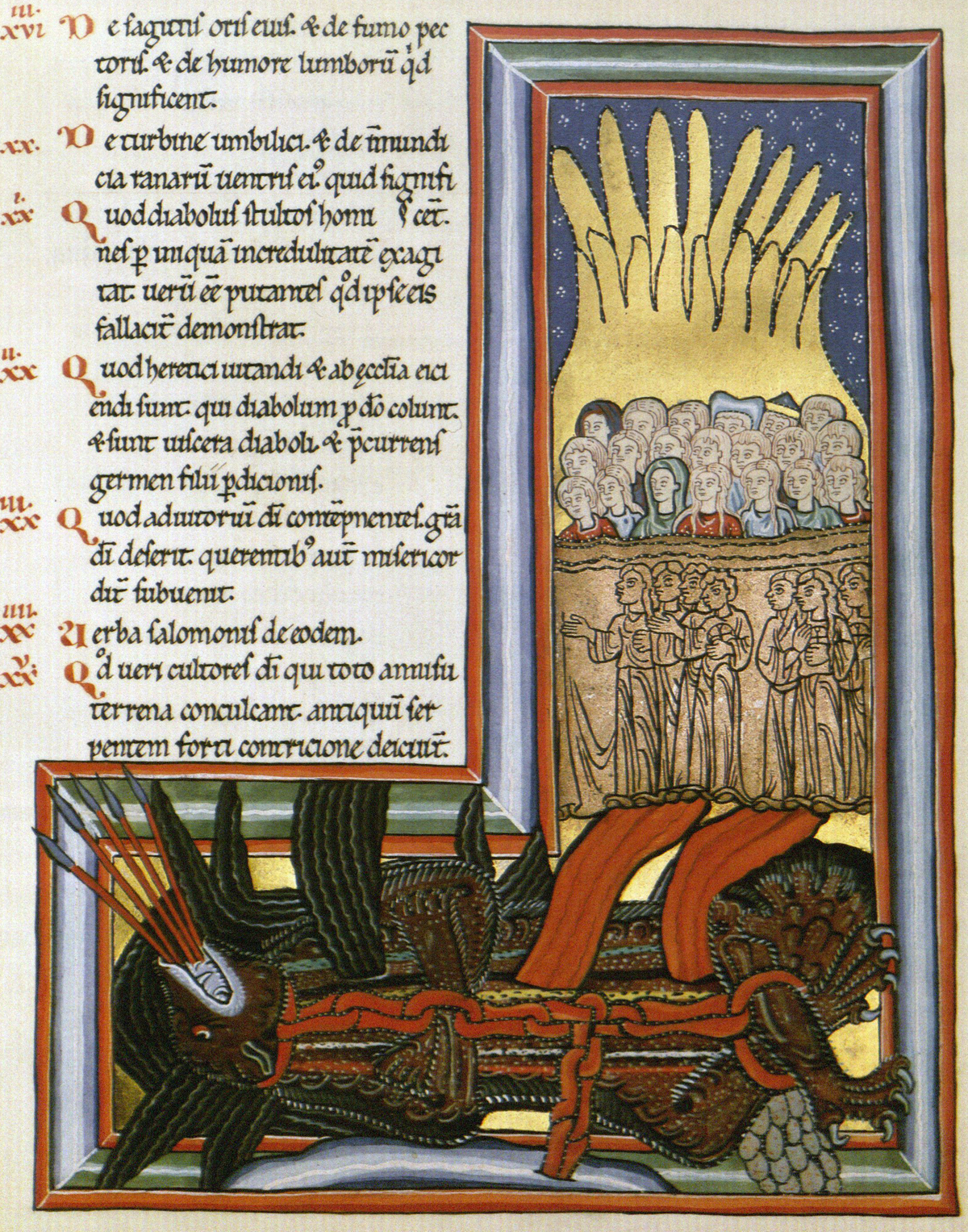
Illustration above: Hildengard von Bingen, Rupertsberg Scivias Manuscript, 1151 or 1152, original lost in 1945, the image is from a facsimile
Outline:
9 November – Medieval Illuminations 1. The first session will be on materials, techniques, where the pictures are found, and what the pictures’ purposes were, i.e the relationship picture/text. Marginalia, initials, full-page illuminations.
16 November – Medieval Illuminations, 2. The second session will be about the main styles in medieval illumination from the more abstract Insular style to the naturalism of courtly manuscripts of the late Gothic period.
23 November – The Illustrated Book, Part 1: From the Printing Press to William Blake. We’ll start with the invention of the printing press and see illustrations made by Dürer and Botticelli. We will then focus on the unusual and innovative case William Blake’s art, blending the image and the word.
30 November – The Illustrated Book, Part 2: From Poetry and Botany to Children’s Books (19th & 20th c.). In this session, we will see how technological advances and the industrialisation contributed to the continued democratisation of illustrated book. Once a luxurious object for the elite, it is now in everybody’s hands. What has the artist’s role and place been in this development? We will take examples from novels and fairy tales, to poetry and botany. Among the artists we will study there will be Tove Jansson, Marianne North, Beatrix Potter, and Chagall. We will conclude with the “artist’s book”.
7 December – Art for the Press: Reporting, Illustrating, and Laughing. We will look at another relationship between the image and the word, by looking at satirical prints and caricatures (Gillray, Daumier), and other illustrations artists made for newspapers. We will consider the work of artists such as H. Daumier, H. Herkommer and the members of the Ashcan School.
Cost: £ 70
Payment is via Stripe with your bank card. It is easy and safe. If necessary, refunds can be processed with Stripe. A few days after you’ve paid you will receive a confirmation email from me. The Zoom link is sent to you a week before the session, and then again the day before.
Please check the terms and conditions to see the policy about cancellations and refunds. If you have any issues or questions, do not hesitate to get in touch (see “contact” above).
This course is now full!

Leave a Reply